
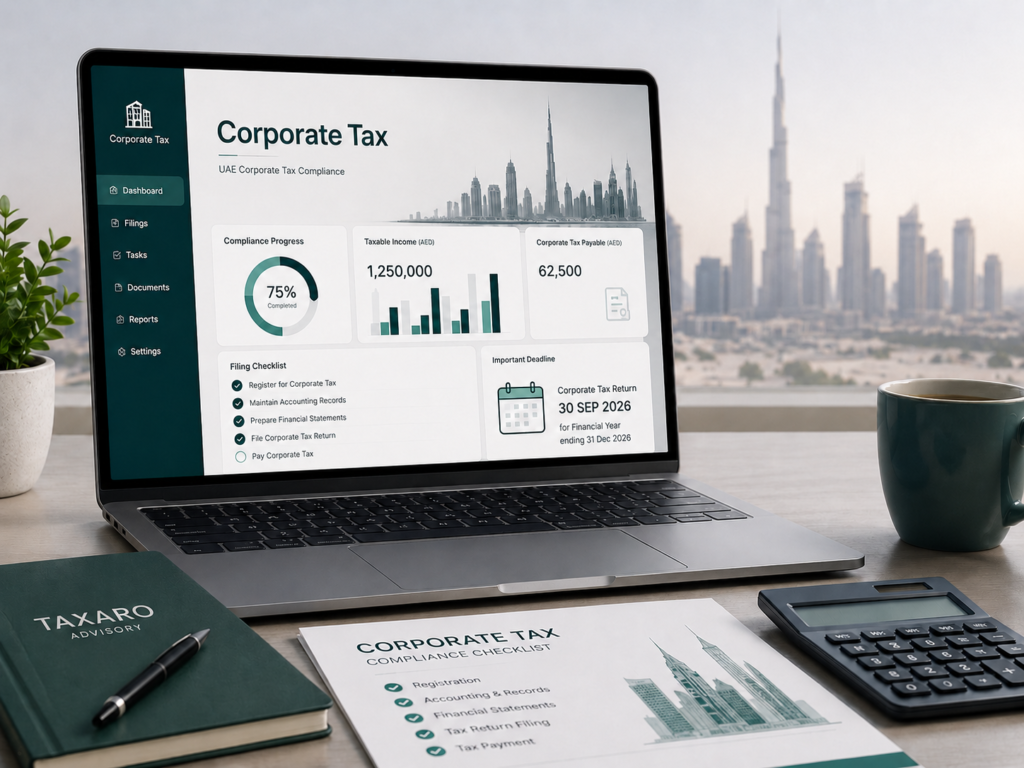
Quick Summary
UAE Corporate Tax applies at 0% on taxable income up to AED 375,000 and 9% above AED 375,000. Most UAE companies must register and file a Corporate Tax Return, even if no tax is payable.
Free Zone companies may qualify for 0% Corporate Tax only if they meet the conditions of a Qualifying Free Zone Person. Small Business Relief may be available for eligible Resident Persons with revenue up to AED 3,000,000.
Corporate Tax Returns and payments are generally due within 9 months after the end of the tax period.
What is UAE Corporate Tax?
Short answer: UAE Corporate Tax is a federal direct tax on the taxable income of businesses operating in the UAE.
UAE Corporate Tax is a federal direct tax on the taxable income of companies and other businesses operating in the UAE. It is calculated based on accounting profit, adjusted under the Corporate Tax Law where required.
Corporate Tax is not the same as VAT. VAT is charged on taxable supplies, while Corporate Tax applies to business profits. A company may have VAT obligations, Corporate Tax obligations or both, depending on its activity, turnover, structure and registration status.
The UAE Corporate Tax regime applies to financial years starting on or after 1 June 2023. For many businesses with a calendar financial year, the first Corporate Tax period started on 1 January 2024.
What are the UAE Corporate Tax rates in 2026?
Short answer: UAE Corporate Tax applies at 0% on taxable income up to AED 375,000 and 9% on taxable income above AED 375,000.
Important: The threshold applies to taxable income, not revenue. Businesses should calculate taxable income based on accounting profit with tax adjustments.
This means that a company is not automatically tax free just because it is small. The AED 375,000 threshold applies to taxable income, not total revenue. A business can have revenue above AED 375,000 and still have taxable income below AED 375,000 after allowable expenses and adjustments.
For example, if a mainland company has taxable income of AED 500,000, the first AED 375,000 is taxed at 0% and the remaining AED 125,000 is generally taxed at 9%. The Corporate Tax payable in this simplified example would be AED 11,250.
Small businesses should be careful not to confuse taxable income, accounting profit, revenue and cash balance. These are not the same thing, and confusing them can lead to wrong tax planning.
Who needs to register for Corporate Tax in the UAE?
Short answer: Most UAE companies and taxable persons must register for Corporate Tax and obtain a Corporate Tax Registration Number.
Important: Individuals are treated differently from companies. A natural person is generally only subject to UAE Corporate Tax if they conduct a business activity in the UAE and the turnover from those activities exceeds AED 1 million in the calendar year.
Most UAE companies and other taxable persons must register for Corporate Tax and obtain a Corporate Tax Registration Number. This generally includes mainland companies, Free Zone companies and UAE entities that are incorporated or effectively managed and controlled in the UAE.
Corporate Tax can also apply to non resident companies if they have a permanent establishment or taxable nexus in the UAE.
For individuals, the rule is more specific. A natural person is generally subject to UAE Corporate Tax only if they conduct a business or business activity in the UAE and the total turnover from those business activities exceeds AED 1 million in the calendar year.
This distinction matters. A freelancer, consultant or sole proprietor should not assume they are automatically outside the rules. At the same time, not every individual with personal income is automatically subject to Corporate Tax.
Do Free Zone companies pay Corporate Tax in the UAE?
Short answer: Free Zone companies are within the scope of UAE Corporate Tax and must usually register and comply with filing obligations.
Important: A Free Zone license does not automatically mean 0% Corporate Tax. A company must meet the conditions of a Qualifying Free Zone Person to benefit from 0% Corporate Tax on Qualifying Income.
Free Zone companies are within the scope of UAE Corporate Tax and must usually register and comply with filing obligations. However, a Free Zone company may benefit from a 0% Corporate Tax rate on Qualifying Income if it meets the conditions to be treated as a Qualifying Free Zone Person.
This is one of the most misunderstood areas of UAE Corporate Tax.
A Free Zone license does not automatically make a company tax free. A Free Zone company must still understand its income streams, customer base, activities, substance, financial records and compliance obligations.
In practical terms, a Free Zone company should review whether it has Qualifying Income, whether it earns income from mainland UAE customers, whether it performs excluded activities, whether it meets substance requirements and whether it has proper accounting records.
If the conditions are not met, the Free Zone company may lose the 0% Corporate Tax benefit and become subject to the standard Corporate Tax treatment.
What is Small Business Relief in the UAE?
Short answer: Small Business Relief may be available for eligible UAE Resident Persons with revenue of AED 3,000,000 or less in the relevant tax period.
Important: Small Business Relief is not automatic. It must be elected for the relevant tax period and does not apply to every business, including Qualifying Free Zone Persons.
Small Business Relief is a Corporate Tax relief for eligible UAE Resident Persons with revenue of AED 3,000,000 or less in the current and all previous relevant tax periods.
If the relief is validly elected, the business is treated as not having derived taxable income for that tax period. This can reduce the Corporate Tax compliance burden for eligible small businesses.
However, Small Business Relief is not automatic. It must be elected for each tax period and only applies if the conditions are met.
A Qualifying Free Zone Person cannot elect for Small Business Relief. Members of multinational groups with consolidated group revenue above AED 3.15 billion are also excluded.
This means small businesses should not rely only on the AED 375,000 taxable income threshold. They should also check whether Small Business Relief may apply, whether the AED 3,000,000 revenue condition is met and whether using the relief is actually suitable for their business.
What are the Corporate Tax filing deadlines in the UAE?
Short answer: Corporate Tax Returns and Corporate Tax payments are generally due within 9 months from the end of the relevant tax period.
Important: Corporate Tax compliance should not start in the filing month. Businesses should maintain bookkeeping throughout the year to avoid missing records, rushed filings and inaccurate Tax Returns.
Corporate Tax Returns and Corporate Tax payments are generally due within nine months from the end of the relevant tax period.
For example, if a company has a financial year ending on 31 December 2025, the Corporate Tax Return and any Corporate Tax payable would generally be due by 30 September 2026.
This deadline is important because many small businesses wait until the filing month before preparing their accounts. That is risky. If bookkeeping has not been maintained during the year, the company may struggle to prepare an accurate Corporate Tax Return on time.
Corporate Tax compliance is not only a year end task. It should be managed throughout the year with proper bookkeeping, monthly reconciliation and accurate documentation.
Why is bookkeeping important for UAE Corporate Tax?
Short answer: Corporate Tax Returns and Corporate Tax payments are generally due within 9 months from the end of the relevant tax period.
Important: Corporate Tax compliance should not start in the filing month. Businesses should maintain bookkeeping throughout the year to avoid missing records, rushed filings and inaccurate Tax Returns.
Corporate Tax Returns and Corporate Tax payments are generally due within nine months from the end of the relevant tax period.
For example, if a company has a financial year ending on 31 December 2025, the Corporate Tax Return and any Corporate Tax payable would generally be due by 30 September 2026.
This deadline is important because many small businesses wait until the filing month before preparing their accounts. That is risky. If bookkeeping has not been maintained during the year, the company may struggle to prepare an accurate Corporate Tax Return on time.
What records must UAE businesses keep for Corporate Tax?
Short answer: UAE businesses must keep records and documents that support the information included in their Corporate Tax Returns.
Important: Relevant records should generally be retained for at least 7 years after the end of the tax period. If a transaction affects revenue, expenses, assets, liabilities or tax position, the business should be able to support it with documentation.
UAE businesses subject to Corporate Tax must keep records and documents that support the information included in their Tax Returns. These records help the Federal Tax Authority verify taxable income.
In practice, this usually includes sales invoices, purchase invoices, bank statements, payment records, contracts, expense receipts, payroll records, asset records, liability records and financial statements.
Taxable Persons and certain Exempt Persons must generally retain relevant records for at least seven years after the end of the tax period to which they relate.
A simple but realistic rule is this: if a transaction affects your revenue, expense, assets, liabilities or tax position, you should be able to prove it with proper documentation.
Do small businesses always have to pay Corporate Tax?
Short answer: No, small businesses do not always have Corporate Tax payable, but they may still have registration, bookkeeping and filing obligations.
Important: Startups should separate business and personal expenses early. Clean bookkeeping makes it easier to manage growth, prepare filings, attract investors and explain the company’s financial position.
Small businesses do not always have Corporate Tax payable, but they may still have registration, bookkeeping and filing obligations.
A business with taxable income up to AED 375,000 may fall within the 0% taxable income band. A qualifying small business may also be able to elect for Small Business Relief if its revenue is AED 3,000,000 or less and all conditions are met.
However, this does not mean the business can ignore Corporate Tax. Registration may still be required. A Tax Return may still need to be filed. Records still need to be maintained.
The practical message is simple. Even if your expected Corporate Tax payable is zero, your compliance obligations may not be zero.
What are the most common UAE Corporate Tax mistakes?
Short answer: Common mistakes include late bookkeeping, assuming all Free Zone companies are tax free, mixing personal and business expenses and confusing VAT with Corporate Tax.
Important: Many Corporate Tax problems are created before the filing deadline. Businesses should review their records, structure and income streams during the year, not only when the Tax Return is due.
One common mistake is assuming that Corporate Tax only matters when the company becomes highly profitable. In reality, registration, filing and record keeping can apply before a business has any tax payable.
Another mistake is assuming that every Free Zone company is automatically taxed at 0%. Free Zone treatment depends on conditions, not only on the location of the license. Many founders also mix personal and business expenses. This creates accounting confusion and can make it harder to support deductions.
A further mistake is waiting until year end before organizing bookkeeping. This often leads to missing documents, rushed reconciliations and inaccurate financial statements.
Some businesses also confuse VAT and Corporate Tax. VAT registration thresholds, VAT returns and VAT payments are separate from Corporate Tax registration, Corporate Tax Returns and Corporate Tax payments.
The final major mistake is not reviewing the company structure and income streams early enough. A company that understands its Corporate Tax position during the year has more time to correct issues before filing deadlines arrive.
How can small businesses prepare for UAE Corporate Tax in 2026?
Short answer: Small businesses should prepare by building a reliable monthly accounting process and keeping accurate records throughout the year.
Important: he goal is not to make accounting complicated. The goal is to make the business easy to explain, easy to file and easy to defend if the FTA asks questions.
Small businesses should prepare for Corporate Tax by building a reliable monthly accounting process.
The starting point is to keep company and personal finances separate. All business income should go through the business account where possible, and all business expenses should be supported by invoices or receipts.
Bank accounts should be reconciled monthly. Sales invoices should be recorded consistently. Supplier bills should be stored properly. VAT status should be monitored. Profit and loss reports should be reviewed before the year end, not only after it.
Businesses should also confirm their Corporate Tax registration status, understand their tax period, check their filing deadline and assess whether Small Business Relief or Free Zone treatment may be relevant.
The goal is not to make accounting complicated. The goal is to make the business easy to explain, easy to file and easy to defend if the FTA asks questions.
When should a small business work with an accountant?
Short answer: A small business should work with an accountant before Corporate Tax filing becomes urgent.
Important: Waiting until the deadline may look cheaper, but it often creates more cleanup work, more pressure and a higher risk of inaccurate filings.
A small business should consider working with an accountant before Corporate Tax filing becomes urgent.
The best time is usually when the company starts generating regular revenue, registers for VAT, hires staff, works with multiple suppliers, operates across mainland and Free Zone structures or expects taxable profit.
An accountant can help organize bookkeeping, prepare financial statements, review VAT exposure, check Corporate Tax obligations and reduce the risk of late or inaccurate filings.
Waiting until the deadline may appear cheaper, but it often creates higher risk and more cleanup work.
Final thoughts on UAE Corporate Tax for small businesses
Short answer: UAE Corporate Tax makes proper bookkeeping, timely registration and accurate financial records essential for small businesses.
Important: Corporate Tax has not made the UAE unattractive for business. It has simply raised the standard of financial discipline expected from serious and compliant companies.
The UAE remains one of the most attractive places in the world to start and grow a business. Corporate Tax has not changed that.
What has changed is the level of financial discipline required from business owners.
Small businesses now need proper bookkeeping, accurate financial records, timely tax registration, clear filing deadlines and a realistic understanding of Free Zone and Small Business Relief rules.
The businesses that handle this early will be in a stronger position. They will have cleaner accounts, better visibility, lower compliance risk and more confidence when making growth decisions.
Understanding UAE Corporate Tax is no longer optional. It is part of running a serious and compliant business in the UAE.
If you run a small business in Dubai or anywhere in the UAE, Taxaro Accounting & Advisory can help you set up reliable bookkeeping, prepare financial reports and stay ready for Corporate Tax compliance.