
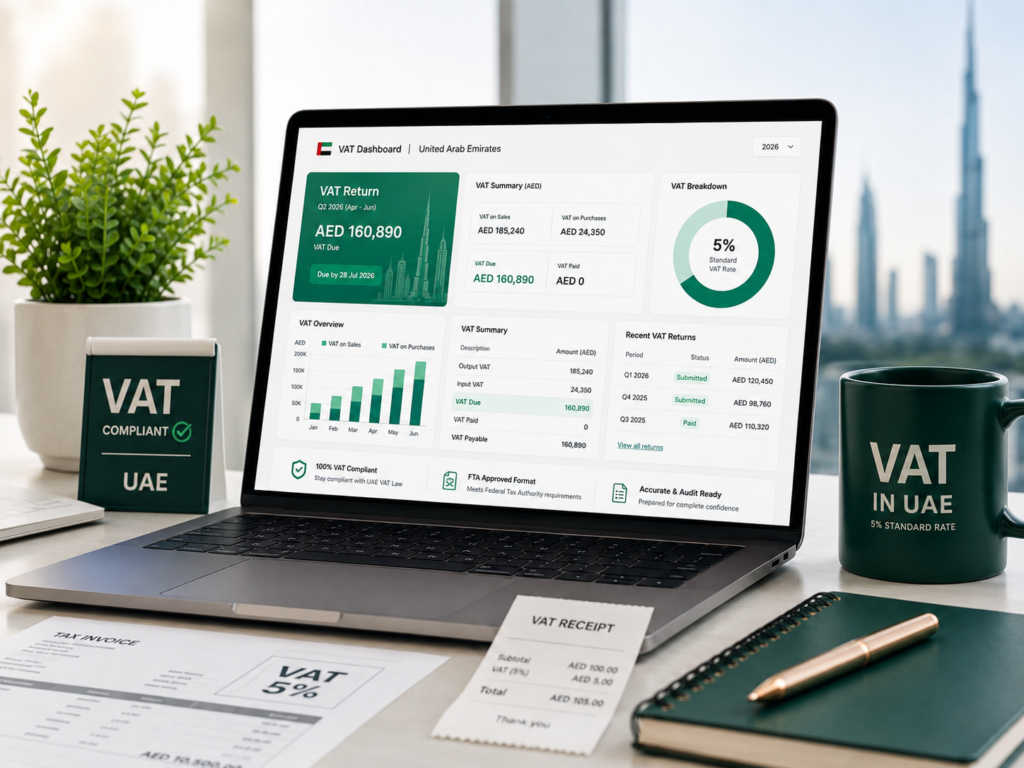
UAE VAT is a 5% tax on most taxable supplies of goods and services. Small businesses must monitor their taxable supplies and imports carefully to understand whether VAT registration is required.
A UAE resident business must generally register for VAT if its taxable supplies and imports exceed AED 375,000 over the previous 12 months or are expected to exceed this threshold in the next 30 days. Voluntary VAT registration may be available from AED 187,500.
What is VAT in the UAE?
Short answer: VAT is a tax on consumption that is charged at each stage of the supply chain and is ultimately borne by the final consumer.
Value Added Tax was introduced in the UAE as part of the country’s tax system and applies to many goods and services supplied by businesses. For small businesses, VAT is not simply an additional charge on invoices. It affects pricing, bookkeeping, cash flow, invoicing, customer communication and tax filing.
A VAT registered business usually charges VAT on taxable sales and may recover eligible input VAT on business expenses, subject to the VAT rules and proper documentation.
What is the UAE VAT rate in 2026?
Short answer: The standard UAE VAT rate is 5% on most taxable supplies of goods and services.
Important: VAT collected from customers should be managed carefully. A business can appear cash positive while building up a VAT liability that must be paid later.
For example, if a VAT registered business sells a taxable service for AED 1,000 excluding VAT, it usually charges AED 50 VAT and invoices the customer AED 1,050.
The VAT collected from customers is not business profit. It is tax collected on behalf of the Federal Tax Authority and must be reported in the VAT Return.
Businesses should therefore avoid treating VAT received from customers as available cash for normal spending.
Who needs to register for VAT?
Short answer: A UAE resident business must generally register for VAT if its taxable supplies and imports exceed AED 375,000 over the previous 12 months or are expected to exceed this threshold within the next 30 days.
Important: The VAT registration threshold is based on taxable supplies and imports, not accounting profit. Do not confuse VAT registration with Corporate Tax profit calculations.
VAT registration is not based on profit. It is based on taxable supplies and imports. This is why a business with low profit can still be required to register for VAT if its taxable revenue exceeds the threshold.
Small businesses should monitor turnover monthly instead of waiting until year end. If the threshold is crossed and the business registers late, penalties and filing problems may arise.
Non resident businesses may have different VAT registration obligations if they make taxable supplies in the UAE and no other party is responsible for accounting for the VAT.
What is voluntary VAT registration?
Short answer: Voluntary VAT registration may be available if taxable supplies and imports or taxable expenses exceed AED 187,500.
Important: Voluntary VAT registration can be useful, but it is not just a badge of credibility. It creates real filing, invoicing and record keeping obligations.
Voluntary registration can be useful for businesses that are growing, working with VAT registered clients or incurring significant taxable business expenses. However, voluntary VAT registration also creates ongoing responsibilities. Once registered, the business must issue proper tax invoices, submit VAT Returns, maintain records and comply with FTA deadlines.
A business should therefore not register voluntarily just because it appears more established. It should first understand the administrative workload, pricing impact and cash flow effect.
How does VAT work for small businesses?
Short answer: VAT registered small businesses charge VAT on taxable sales, record input VAT on eligible expenses and report both in their VAT Returns.
Important: Input VAT can usually only be recovered if the expense is business related and supported by proper documentation, such as a valid tax invoice.
In simple terms, output VAT is VAT charged to customers. Input VAT is VAT paid on eligible business expenses. The difference between output VAT and recoverable input VAT usually determines whether VAT is payable or refundable.
For example, if a business charges AED 5,000 output VAT and has AED 1,500 recoverable input VAT, the net VAT payable would generally be AED 3,500.
This is why bookkeeping matters. Without accurate sales records, purchase invoices and bank reconciliation, VAT Returns become guesswork.
What are taxable, zero rated and exempt supplies?
Short answer: Taxable supplies are subject to VAT at either 5% or 0%, while exempt supplies are not subject to VAT and may restrict input VAT recovery.
Important: A 0% VAT supply is not the same as an exempt supply. Incorrectly treating a standard rated supply as zero rated or exempt can lead to underpaid VAT and potential penalties.
For many small businesses, taxable supplies include normal sales of products or services made in the UAE. These supplies count toward the VAT registration threshold. Some supplies may be zero rated if specific VAT conditions are met. This means VAT is charged at 0%, but the supply may still be treated as taxable for VAT purposes.
Exempt supplies are different. If a business makes exempt supplies, it may not be able to recover input VAT related to those supplies.
Small businesses should not guess whether something is standard rated, zero rated or exempt. The classification affects pricing, invoices, VAT Returns and recoverable input VAT.
What records should UAE businesses keep for VAT?
Short answer: VAT registered businesses should keep records that support their VAT Returns, including tax invoices, credit notes, debit notes, import records, expense documents and accounting records.
Important: Poor records can make VAT filing inaccurate and can also make it difficult to prove whether registration was required at an earlier date.
Good VAT records should show what was sold, when it was sold, to whom it was sold, what VAT was charged and which expenses include recoverable input VAT.
Businesses should also keep bank statements, contracts, payment confirmations, supplier invoices and customer invoices in an organised way. Even businesses that are not yet required to register for VAT should maintain financial records in an orderly manner so they can determine whether VAT registration becomes necessary.
When are VAT Returns due in the UAE?
Short answer: VAT registered businesses must usually file VAT Returns and pay any VAT due within 28 days from the end of the relevant tax period.
Important: Missing the VAT Return deadline can lead to penalties. Businesses should reconcile VAT data before the filing date and keep enough cash available to pay the VAT due.
The tax period may be monthly or quarterly depending on the business and FTA requirements. Many small businesses file quarterly, but the exact due date should always be checked in the EmaraTax account.
The filing deadline is important because VAT is cash sensitive. A business may collect VAT during the period but only pay it after filing. If that money is spent before the deadline, cash flow pressure can arise.VAT Returns should therefore be prepared before the due date, not on the final day.
What are the most common VAT mistakes?
Short answer: Common VAT mistakes include late registration, incorrect invoices, missing input VAT documents, confusing VAT with profit and filing VAT Returns without proper bookkeeping.
Important: VAT mistakes are usually created during the month, not only at the filing deadline. Accurate invoices and monthly bookkeeping reduce the risk significantly.
Many small businesses realise too late that they crossed the VAT registration threshold. Others register on time but continue issuing invoices that do not meet VAT requirements.
Another common mistake is claiming input VAT without a proper tax invoice. Businesses may also forget to check whether expenses are actually business related and recoverable. Some founders also spend VAT collected from customers as if it were revenue. This creates cash flow problems when the VAT payment becomes due.
How does bookkeeping support VAT compliance?
Short answer: Bookkeeping supports VAT compliance by recording taxable sales, input VAT, output VAT, tax invoices, supplier bills and payment records accurately.
VAT Returns depend on clean bookkeeping. If sales are incomplete, expenses are missing or invoices are not stored properly, the VAT Return may be wrong. Monthly bookkeeping helps the business identify VAT payable, check whether input VAT is supported, reconcile bank transactions and prepare the VAT Return without last minute stress.
It also helps the business monitor whether it is approaching the VAT registration threshold before registration becomes urgent.
A small business should consider working with an accountant when it approaches the VAT threshold, becomes VAT registered or struggles to maintain accurate records. This is especially relevant for businesses with imports, exports, ecommerce sales, marketplace activity, real estate related income or cross border services.
Frequently asked questions about our services
What is the VAT rate in the UAE?
The standard VAT rate in the UAE is 5% on most taxable supplies of goods and services.
When does a UAE business need to register for VAT?
A UAE resident business must generally register for VAT if taxable supplies and imports exceed AED 375,000 over the previous 12 months or are expected to exceed that amount in the next 30 days.
Can a business register for VAT voluntarily?
Yes. Voluntary VAT registration may be available if taxable supplies and imports or taxable expenses exceed AED 187,500.
When are VAT Returns due?
VAT Returns and related VAT payments are generally due within 28 days from the end of the relevant tax period.
Is VAT the same as Corporate Tax?
No. VAT is charged on taxable supplies, while Corporate Tax applies to taxable business income or profit.
Do non VAT registered businesses still need bookkeeping?
Yes. Businesses should keep proper financial records even if they are not VAT registered, because records help determine whether VAT registration becomes necessary.